
Victoria Previous Residents by Era
One address needs more than one kind of record. Use the era coverage below to decide whether to begin with the County Clerk, a local directory, a census release, or a library collection. The dates are intentionally uneven. They show the sources located for Victoria, not a promise that every year, image, or address can be searched online.
| Source | Years it covers | Where held | What it can show |
|---|---|---|---|
| County online deed index | Start date not located; current portal | Manatron and County Clerk counter | Transfers and instruments, subject to the portal disclaimer |
| County and archive deeds | Historical materials include 1834-1882 papers and 1837-1847 grants | Clerk, archives, and FamilySearch route | Legal-chain evidence; complete local book run not confirmed |
| City directories | 1900-1901, 1913, 1927, 1939-1956, Polk from 1957 | UHV and Victoria library | Name, address, occupation, and spouse clues where printed |
| Federal census | 1790-1950 public; 1960 due 2032 | Census and library databases | Household at the census date, with timing limits |
| Victoria Advocate | Microfilm from 1876; index 1968-2004 | Victoria Public Library | Notices, obituaries, and address context; older run incomplete |
| Permit reports and Sanborn maps | Permit archive not fully inventoried; Victoria map years not confirmed | City, library, and Library of Congress route | Building-work or structure clues, not an occupant list |
For recent prior residents, begin with the parcel and deed. For a gap between deed transfers, the address section of a directory, a census household, or a newspaper notice may provide the better time marker. When the online record ends, the counter, library, UHV appointment, state archives, and FamilySearch catalog are documented Victoria fallbacks.
Victoria Address Legal Identity
Normalize the current address before moving backward. Victoria CAD can connect the street number and name to a geographic ID and legal description. The City and County Street Index can help recognize directional forms and street-name variants. Preserve the lot, block, subdivision, or metes-and-bounds description with the number because a legal description survives an address change more reliably than a house number alone.
The distinction matters in Victoria's geography. The original town was a one-mile grid around a central plaza, and later annexations expanded the city beyond that pattern. No official source located a dated citywide renumbering or renaming project. An old number should therefore be checked against the street section, plat, GIS position, and legal description, not simply copied into a modern search field.
- Legal description
- The parcel's lot, block, subdivision, or metes-and-bounds identity used in deeds and plats.
- Grantor
- The party conveying an interest in a recorded instrument, often the seller in a deed.
- Grantee
- The party receiving that interest, often the buyer in a deed.
- Chain of title
- The sequence of recorded transfers traced backward through the same parcel identity.
- Enumeration district
- The census area used to organize households for a census count; it is not a parcel identifier.
Victoria Deed Chain Backward
The deed chain answers who held legal title, not automatically who occupied the property. Start with the CAD owner and current legal description, then use the County Clerk's grantor-grantee index to find the instrument conveying the parcel to that owner. Record the parties, date, instrument or book reference, and the legal language before moving to the earlier transaction.
- Find the current parcel through Victoria CAD eSearch and save its owner, situs, mailing field, geographic ID, and legal description.
- Enter the owner and legal description in the County Clerk record path to locate the deed that transferred the parcel to that owner.
- Read the seller, who is the grantor, and search that party as a grantee in an earlier instrument for the same legal description.
- Repeat the transfer sequence while comparing lot, block, subdivision, or metes-and-bounds language at each step.
- When web access stops, ask the County Clerk counter for the relevant deed books or copies, then use archive finding aids and library routes for earlier material.
Victoria archival finding aids identify land-grant material from 1837-1847, Daniel/Linn real-estate and deed material from 1834-1882, and Cartwright tax, deed, plat, and field-note material. Those holdings make useful leads for an old legal description, but they do not establish a complete indexed deed run for every address.
Victoria Recorder Portal Limits
The County Clerk's Aumentum/Manatron portal is reached through a disclaimer gate. The notice says the online copy is not the official repository, may be incomplete or fail to reflect an unaltered record, and may have redactions or unavailable images during backups. The research did not locate a verified online index or imaging cutoff. Do not turn that unknown into an assumed year when tracing past residents.
Use the portal for a current access point, then compare the result with the clerk's counter or a copy request when an older link, image, or book reference is missing. A Texas Public Information Act request is the county fallback for nonexempt information when a normal search route does not provide it. It may be mailed, e-mailed, hand-delivered, or sent through another authorized method; the custodian can seek clarification or apply allowed charges.
Victoria County foreclosure notices provide another dated property event, with materials listed by the county for 2016-2026. A foreclosure notice is not proof of an occupant or final title. Confirm any transfer in the deed index.
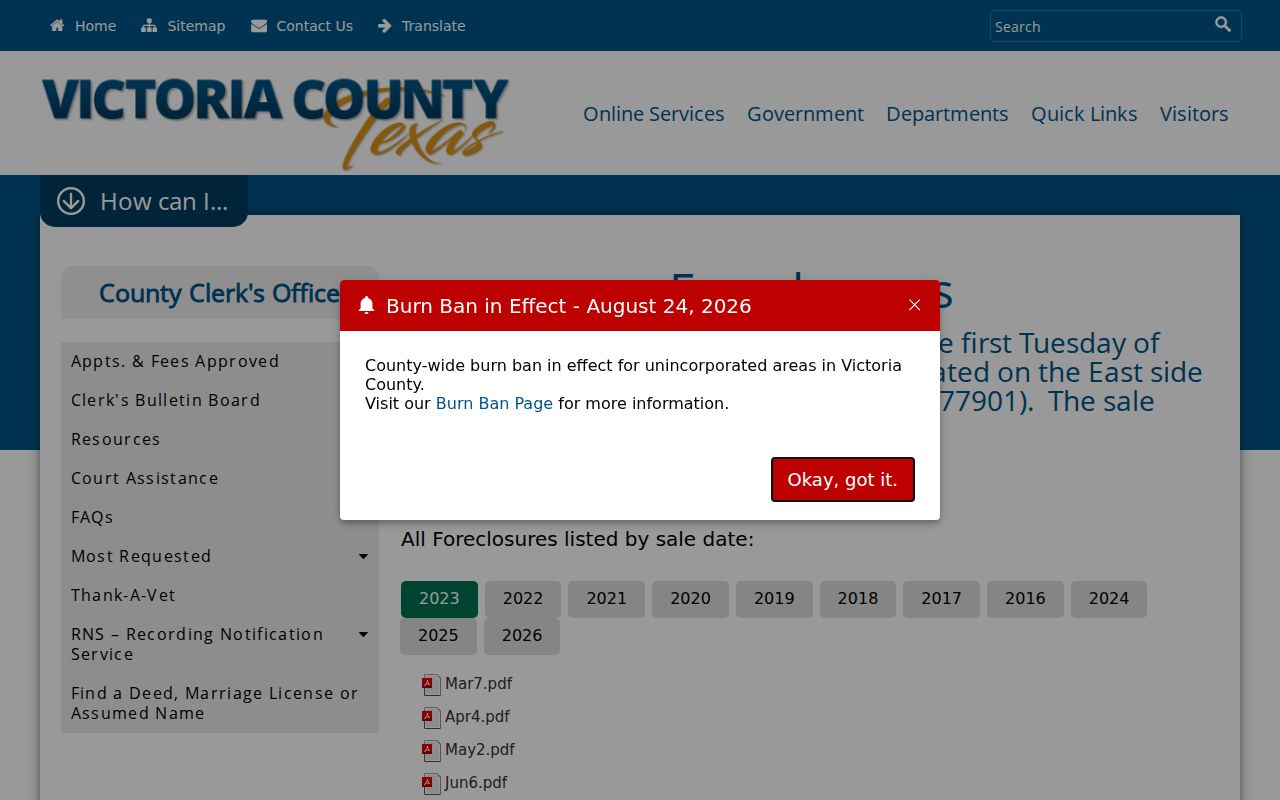
The source image belongs in an address timeline only as a lead. The deed chain remains the record that tests whether and how legal title changed.
Victoria Directory Gaps
Victoria's local runs are not a continuous annual shelf. UHV identifies Scollard & Thomas for 1900-1901, Worley for 1913, Wilder for 1927, C.H. Jackson for 1939-1956, and Polk from 1957 to current reference holdings. The gaps from 1901 to 1913, from 1913 to 1927, and before the 1939 run matter. A no-result in a missing volume says nothing about whether a household lived at the address.
UHV says that directory name sections attempt to include resident and business names rather than acting like simple telephone books. An entry may include an address, spouse, occupation, and other notation if that volume prints it. Keep initials and spelling variants as written. The directory collections themselves are detailed through the Victoria City Directory resource, while this address trail uses their date and street evidence.
Victoria Public Library offers local-history reference, Advocate microfilm, obituary files, and licensed genealogy databases. UHV's Regional History Center is by appointment and may need advance notice for off-site material. Those routes are especially useful when the online deed sequence has no stated cutoff or when an address needs a pre-digital comparison.
Victoria Past Household Trail
Past residents are often found in the reverse or criss-cross street section, not only in the alphabetical name section. Read the address in the relevant volume, preserve the spelling and page, then check the same address in the next available directory. That method identifies a dated listing, not continuous occupancy between volumes. A deed can change the legal owner while another household still appears in the directory.
Pair the directory trail with census years and other dated sources:
- Write down the directory year, street form, house number, and all printed household details.
- Compare the next available local volume rather than assuming an unlocated intervening year exists.
- Find the relevant public census release and compare household members, age patterns, and address evidence where the census identifies the location.
- Use Advocate notices, obituaries, probate, or recorded deeds to test moves, deaths, heirs, or legal transfers between the two dates.
Victoria Advocate microfilm reaches toward 1876, though older months and years are incomplete. Its local subject, title, date, and page indexes cover 1968-2004, while obituary material covers 1981-1992. These are dated context sources, not a substitute for an address listing.
Victoria Census Timing
Federal census data are public through 1950 under the 72-year rule. The 1960 release is not due until 2032. A census captures a household at the date of enumeration, so it should be paired with a directory or deed rather than used as a blanket statement about every year at an address. Library-access resources include HeritageQuest census coverage through 1930 and Ancestry Library Edition in the Victoria Public Library.
The 1890 census was mostly destroyed in the 1921 Commerce Department fire, leaving only partial surviving material. For Victoria, use the directory gaps, Advocate material, deeds, church registers, tax records, and permit evidence to bridge that lost census period. An incomplete source is still useful when its date and limit are stated plainly.
Note: Census release timing controls public availability, not whether a person or a street existed in an earlier year.
Victoria Building Date Clues
Permits can place changes to the building on the same timeline as previous residents. Victoria's monthly reports can show permit type, work class, permit number, project, address, valuation, square feet, owner, contractor, and amount paid. The research captured an example report but did not establish a complete historic permit archive. Treat a permit as a dated work event, not proof that the named owner occupied the property.
Sanborn maps add a different layer. The Texas library guide identifies statewide map coverage from 1867-1970, and a Library of Congress Victoria item exists, but exact Victoria sheet years were not confirmed in the research. Maps can help with building footprint, material, or use. They do not identify the residents. Ask the Victoria Public Library's O'Connor Room about Polk street directories, the Advocate index, local histories, and Sanborn access, then verify a house-history claim with the matching source.
Victoria Previous Residents Endpoints
An obituary, probate file, or deed can close a dated segment of an address history. Victoria Public Library has obituary material and Advocate resources, while the County Clerk and county courts provide local probate routes. Use a death notice or probate filing to identify a possible heir or date, then confirm the property's legal transition through the deed chain. Do not assume that a family member named in an obituary took title to the house.
For Victoria records that are not exposed by the portal, ask the custodian what counter, copy, archive, or appointment route covers the period. The Texas State Library and Archives provides a statewide bridge to city directories, microfilmed county records, newspapers, and census routes. FamilySearch's Victoria center and UHV special collections are additional reference paths, but no specific digitized Victoria deed-book collection title or complete year run was located.
Victoria Previous Residents Limits
Researching who lived here before is different from identifying every living person associated with an address. Ownership, mailing, voter, directory, and census data each describe a limited relationship at a stated time. Protected voters, confidential addresses, utility customers, and household members may not appear. A same-name hit or a tax mailing field should never be used to infer a current resident.
Keep a simple research log: the source, date, address form, legal description, and what the record actually shows. That makes a gap visible and prevents an old directory, a portal disclaimer, or an unknown cutoff from being mistaken for a fact.