
Victoria City Directory Collections
Victoria's documented local directory holdings begin with named publishers and uneven spans, so the year on the title page matters. The strongest local collection record is maintained by the UHV Regional History Center. Its list identifies the early Scollard & Thomas, Worley, Wilder, C.H. Jackson, and Polk volumes rather than presenting a generic directory run. Victoria Public Library also keeps relevant reference material, while the Texas State Library and Archives offers statewide directory routes. The table separates the shelf evidence from companion sources that help confirm a household.
| Collections | Years | Where Held | Access |
|---|---|---|---|
| Scollard & Thomas, Victoria City Directory | 1900-1901 | UHV VRHC, Special Collections F392.V52V | By appointment |
| Worley's and Wilder's Victoria directories | 1913; 1927 | UHV VRHC, F392.V52V | By appointment |
| C.H. Jackson directory | 1939-1956 | UHV VRHC, F392.V52V | By appointment |
| R.L. Polk & Co. directory | 1957-Current | UHV and Victoria library reference | Current issues at first-floor reference |
| Victoria Advocate and obituary material | Microfilm from 1876; index 1968-2004; obituaries 1981-1992 | Victoria Public Library | In-library reference |
The directory sequence has real gaps. No located volume bridges 1901 to 1913 or 1913 to 1927, and the exact year-by-year gaps within the Polk period have not been enumerated. A missing name in an unlocated year is not proof that the person left Victoria.
Victoria Directory Collection Quirk
The publisher changes give the Victoria collection a useful timeline. It also prevents a researcher from assuming that every decade has a comparable book. The UHV list supplies the firm names and spans below. Each volume should be cited by its printed year and publisher because an address, notation, or street arrangement can vary from one series to the next.
- 1900-1901: Scollard & Thomas published the earliest located Victoria run.
- 1913: John F. Worley Directory Co. is represented by one located volume.
- 1927: H.B. Wilder is represented by one located Victoria directory.
- 1939-1956: C.H. Jackson Directory Co. supplies the defined pre-Polk window.
- 1957-Current: R.L. Polk & Co. is listed from 1957 forward, with unlisted internal gaps possible.
The collection has a numerical quirk: five distinct publisher or era blocks, rather than a single uninterrupted sequence. Keep the gaps visible in a family timeline. The next available directory can show a later address, but it cannot date a move to the missing years.
Reading Victoria City Directory Entries
UHV describes the name section as including occupation and spouse information and as attempting to include resident and business names, not merely telephone subscribers. That makes a printed volume helpful for sorting people with similar names, but an entry must be read exactly as printed. The local inspection did not expose a page scan, so no field should be presumed when a particular volume does not display it. Start by copying the volume, page, spelling, initials, and all abbreviations.
| Name as printed | Preserve initials, surname spelling, and any maiden-name or widow notation. |
|---|---|
| Spouse | Record a spouse in parentheses when the entry shows one. |
| Occupation | Copy the occupation exactly when present; it can distinguish same-name entries. |
| Street address | Keep the number, directional letter, street form, and suffix as printed. |
| Classification or mark | Note business or residence classification and any owner or renter notation only if shown. |
| Source detail | Save the page, volume year, publisher, and abbreviation-key meaning. |
- Criss-cross directory
- A street-order section that can lead from an address to an occupant, instead of from a name to an address.
- Householder index
- A listing organized around the household or address, when a volume supplies one; its arrangement should be checked in that volume.
- Abbreviation key
- The volume's own list explaining shortened words and marks. Photograph or transcribe it before interpreting an entry.
Victoria City Directories by Street
The Victoria volumes are not useful only for alphabetical names. UHV specifically describes a reverse or criss-cross approach in which the street address leads to an occupant. Once a name entry produces an address, read the street section for that same year before drawing a household conclusion. The street section can reveal the address as it appeared in the book and can place other listed occupants nearby.
Directional streets need special care. Research for Victoria cautions that E, W, N, and S variants, initials, and old lot or block language can cause a false negative when a modern street string is entered unchanged. The city and county street index, plats, and legal descriptions are better tools for resolving a physical-address question. For the current address-record workflow, use the Victoria streets directory rather than treating an old reverse section as proof of a present household.
Tracing Victoria Directory Households
Directory years work best as markers between household records. Victoria's local sources support a careful sequence: read the earliest available listing, keep spelling variants, use the reverse section, then move only to the next located year. Federal census material is public through 1950 under the 72-year rule, while 1960 is not scheduled for release until 2032. A directory can bridge time between those releases, but it cannot replace the census household schedule.
- Find the first located Victoria entry for the name, then record its page, address, spouse, occupation, and abbreviations.
- Check that address in the volume's street or reverse section and preserve any different spelling or numbering.
- Move to the next available directory year, not an assumed annual edition, and make a dated address line for each finding.
- Pair the dated lines with the appropriate public census year and keep the 1890 destruction gap in mind.
- Use a notice, obituary, probate file, or deed to test whether a disappearance reflects a move, death, or another same-name person.
A name that disappears has several possible explanations. The household may have moved, the person may be unlisted, a spelling may have changed, or the next local volume may not exist. A second source is needed before two same-name people are combined into one timeline.
Victoria Library Directory Sources
The Victoria Public Library genealogy collection puts the O'Connor Room at the center of local reference work. The room is in-library only and shelves Victoria material near call number 976.4125. Its documented sources include city directories, Polk street and address material, Advocate microfilm and index material, obituary files, yearbooks, genealogy books, and licensed Ancestry, HeritageQuest, Fold3, and Newspapers.com resources. The library lists hours as Monday and Wednesday 9-7, Tuesday, Thursday, and Friday 9-6, and Saturday 10-5.
The library's genealogy page identifies the databases and local-history access points available to a researcher.
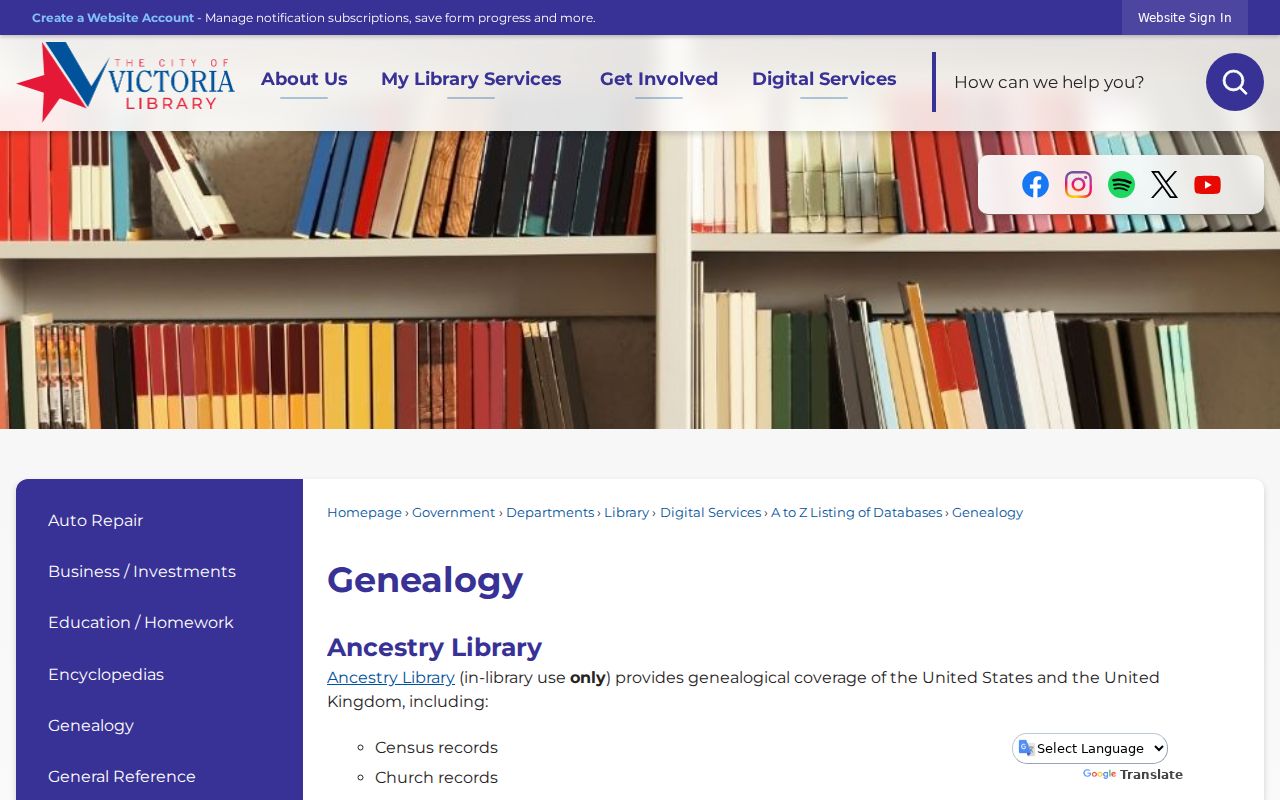
Use the O'Connor Room for the physical directory and local newspaper layer, then compare an entry with a database result only when the dates line up. Library access terms apply to the licensed databases, and the research does not establish a single remote-access rule for all of them.
Victoria Archives Directory Access
UHV Regional History Center at 3006 N. Ben Wilson holds the listed directory volumes, county histories, German-American material, and St. John Evangelical Lutheran records from 1850-1977. It works by appointment, can require advance contact for off-site material, and lists 361-570-4169. This is the main local fallback when a book is too rare for a general reference shelf. The Victoria FamilySearch center, at 3408 N. Ben Wilson, operates Wednesdays 6-9 or by appointment and can assist with catalog and affiliate-center routes.
UHV's regional Texas resources listing is the source for the publisher runs and Special Collections call number.
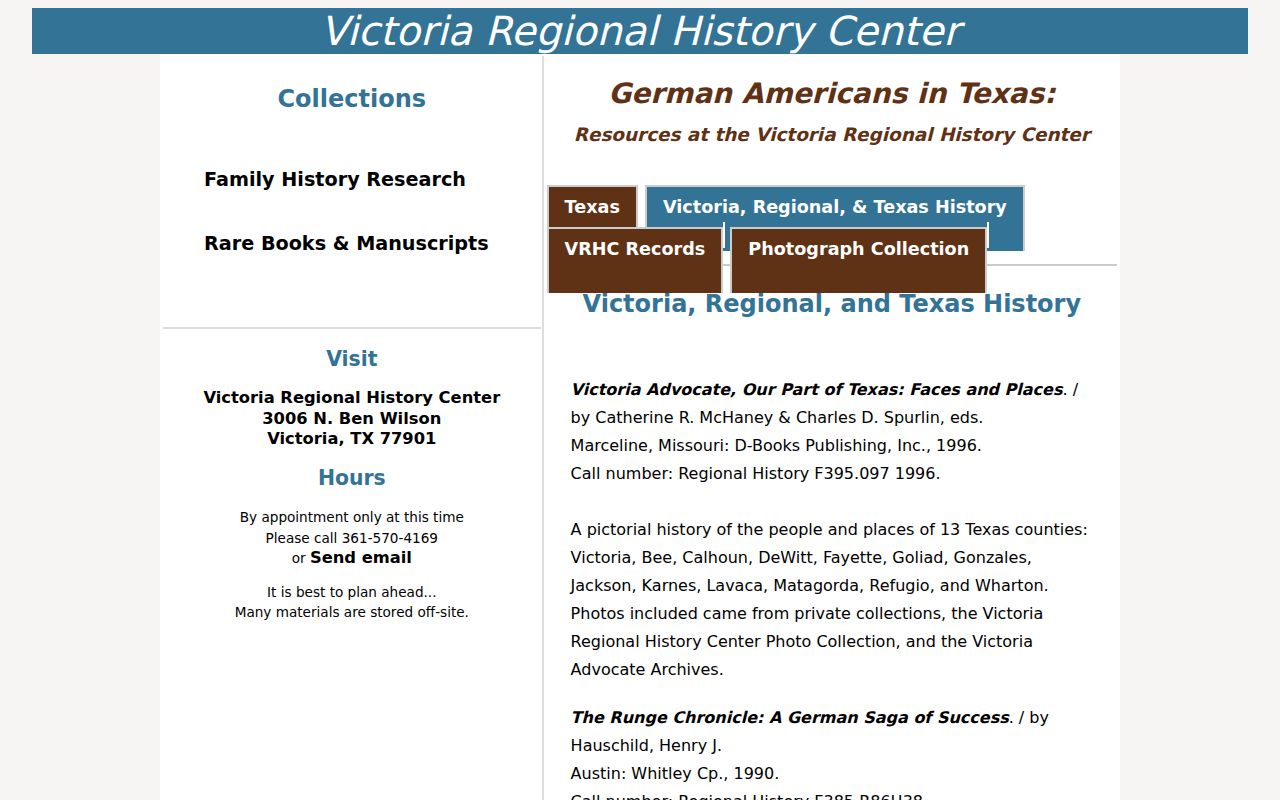
The UHV appointment path complements library reference access. It does not establish that every local directory volume is digitized or available by phone or email.
The Texas State Library and Archives directory resource adds statewide routes through the UNT Portal to Texas History, UT Briscoe Texas Directories, Ancestry U.S. City Directories, and on-site print or microform. Its staff do not search or transcribe collections by phone or email, so search by county and year in the digitized portals or plan an in-person visit.
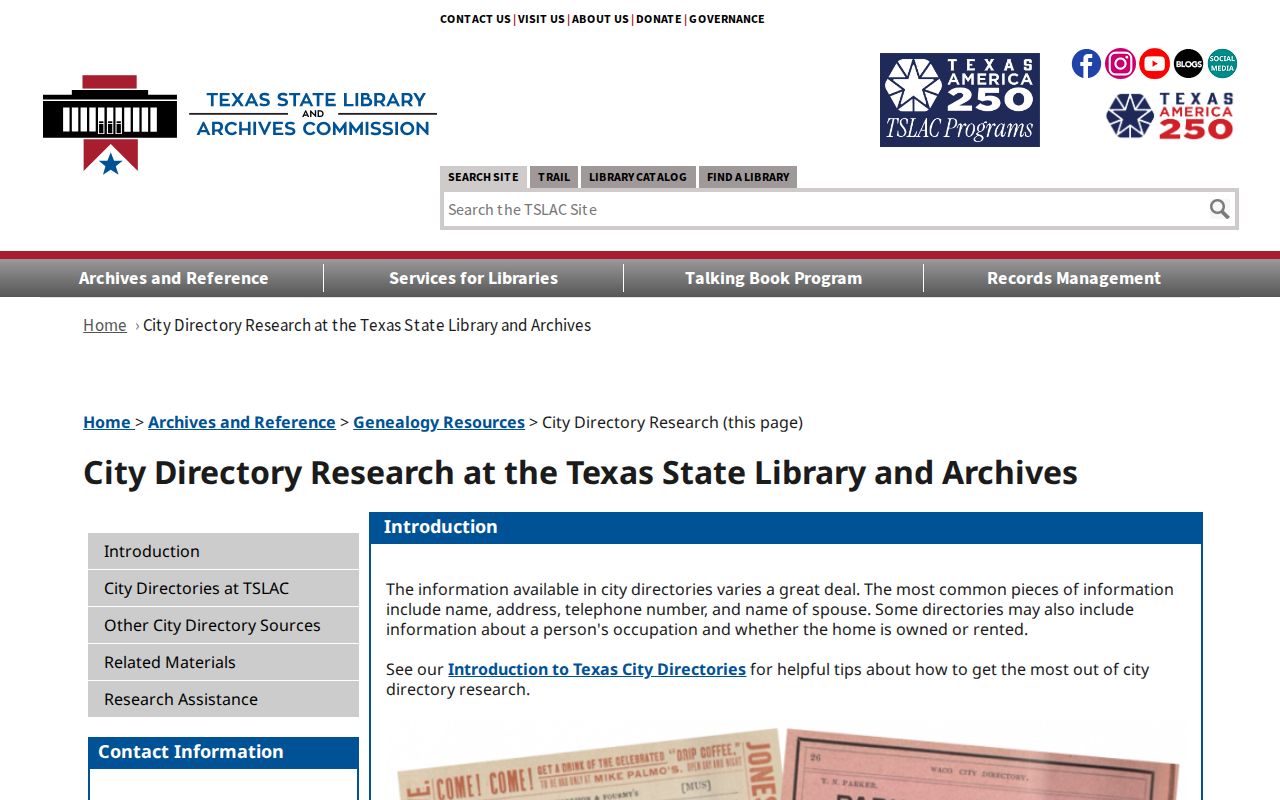
The state route can fill a statewide research need, while the UHV and library holdings remain the best documented local shelves for Victoria volumes.
Victoria Directory Gaps and Census
Victoria's one-mile grid and later annexations make old addresses harder to compare with a modern map. The city expanded from 2,013 acres in 1950 to 22,640 acres in 2007. No official dated citywide renumbering or street-renaming event was found. Treat the street number in a historical directory as a starting point, then test it with the street index, lot and block language, plats, deed descriptions, and GIS rather than assuming a direct modern match.
The federal census has its own interruption. Public releases reach 1950, 1960 remains closed until 2032, and most of the 1890 census was destroyed in the 1921 Commerce Department fire. Directories, newspapers, deeds, church registers, tax records, and permits can help bridge those blank spaces. None of them should be described as a replacement for the missing census schedule.
Victoria Directory Source Comparison
The Victoria Advocate is a useful companion when a directory shows an arrival, disappearance, or address change. Library microfilm reaches toward 1876, but older months and years are incomplete. The local subject, title, issue-date, and page index spans 1968-2004, while the obituary files cover 1981-1992 and are arranged alphabetically by month. After 2004, the library guide directs readers to the Advocate website.
The contrast matters for planning: directory volumes place a person in a particular publication year, while the Advocate can supply a dated notice or event. Obituaries and notices should be searched with initials and name variants, then tested against the directory address. The research located no official city-run cemetery database, so that gap requires separate city, county, church, or funeral-home research.
Note: Keep the directory page and the newspaper citation together so a later reader can distinguish an address listing from a dated notice.