
Finding Victoria Residents by Record Trail
Victoria has no official master roster of every person in town. The useful record changes with the fact in hand. A deed or CAD card can tie an owner to a parcel. A voter file can identify public registration fields for an eligible voter, subject to confidentiality rules. A city directory can place a household in a particular published year. Court, probate, business, and obituary material may then confirm that a same-name result belongs to the right person.
Start with the narrowest reliable detail, such as a full name, an address, or an approximate date. Treat a name-only hit as a lead, not a conclusion. Renters, other household members, confidential voters, and people whose address is protected can be absent from the public trail. The best Victoria residents directory search compares independent records instead of expecting one list to settle every question.
- Search Victoria CAD by owner, street, parcel, or legal-description clue when the question concerns a property.
- Compare the situs address, which identifies the parcel, with the separate tax mailing address.
- Use the county clerk’s recorded-instrument index for a deed transfer, then note the legal description and recording date.
- Check the proper court, voter, vital, library, or archive channel for a second dated fact.
- When the web result stops, ask the custodian, submit a written request, or use the local-history shelf.
Note: A property owner, a mailing recipient, and a current occupant can be different people, so label each fact before comparing it.
Victoria Residents Directory Offices
Several public offices form the working core of a Victoria residents directory search. The Victoria County Clerk keeps recorded property instruments, marriage licenses, probate material, and county records. Victoria Central Appraisal District manages parcel and appraisal data. The Elections Administrator handles voter resources and file requests. Their records overlap, but their purposes and access rules do not. The county clerk’s web copy is not the official repository, while CAD and elections data have their own limits.
Victoria County Clerk
115 N. Bridge St., Room 103
Victoria, TX 77901
361-575-1478
Victoria Central Appraisal District
2805 N. Navarro, Suite 300
Victoria, TX 77901
361-576-3621
Victoria County Elections
2805 N. Navarro, Suite 500
Victoria, TX 77901
361-576-0124
The Victoria streets resource follows the address side of this process in more detail, including parcels, legal descriptions, and historical street sections.
Victoria CAD Name and Address Search
The Victoria CAD eSearch portal is the strongest current property starting point. Its visible search choices include Owner Name, Street Number, Street Name, Property ID, Geographic ID, Subdivision, Condo, Neighborhood, Abstract, Property Type, and Tax Year. The portal asks users to enter a street name without prefixes, suffixes, or unit numbers. A simpler street or name string can work better than a fully formatted address when the first attempt returns no parcel.
A returned parcel can show an owner, situs address, mailing address, legal description, tax-year information, and other appraisal facts. It does not establish that every person living at the physical address is listed. Use a deed or a dated directory entry when a Victoria resident trail needs confirmation beyond the CAD record.
| Victoria CAD field | Best use | Research caution |
|---|---|---|
| Owner Name | Start with a likely property owner | Use last-name, first-name format when needed |
| Street Number and Street Name | Find a parcel by physical location | Omit prefixes, suffixes, and unit numbers from Street Name |
| Property or Geographic ID | Reconnect a parcel after mapping it | Copy the identifier exactly |
| Subdivision, Condo, Neighborhood | Narrow a broad result | Autocomplete options were observed, but complete values were not captured |
| Tax Year | Review an available assessment year | The inspected page did not state its earliest coverage year |
Copy the result’s parcel identifier and legal description before leaving the record. The identifier connects CAD to the map, while the legal description is the stronger bridge to a deed. A tax mailing address can help locate a record, but it is not interchangeable with the situs address. Compare both fields carefully, then use the clerk’s index or a dated directory source to test the relationship suggested by the CAD result.
Victoria Recorder Alerts and Limits
The county clerk’s Aumentum/Manatron public-access portal opens through a disclaimer acknowledgment. The county says that web material may be incomplete, may not reflect the unaltered official record, and can be affected by redactions or image availability. Its exact online index cutoff was not located in the official research. That uncertainty matters when a Victoria residents directory search reaches an older deed or instrument.
For future recordings, the clerk also offers Recording Notification Service. It is free with a valid email address and alerts a registrant when a matching grantor or grantee name is recorded. It is not a title search. Only required grantor and grantee names must be indexed, and the county gives no completeness guarantee. For a historic document, call or visit the clerk and ask about the particular instrument, copy, certification, or archive request.
Current Victoria Resident Directory Sources
Current directories in Victoria are purpose-built records, not one census of households. CAD is strongest for property ownership. Voter information is held through county and state election channels. Recorded instruments identify parties to a filing. The city staff directory lists public employees in their official roles. Each source can help locate or verify a fact, but none should be stretched into proof that every person at an address is present.
| Victoria source | What it can show | Custodian | Access path |
|---|---|---|---|
| CAD parcel record | Owner, situs, mailing, legal and tax facts | Victoria CAD | Public eSearch and map |
| Recorded instrument | Grantor, grantee, transfer date, legal description | County Clerk | Portal, counter, or copy request |
| Voter roster or file | Public voter fields for the selected request | County Elections | Roster links or written request |
| City staff directory | Official city personnel contacts | City of Victoria | Public category and name search |
| License or entity filing | Public filing or credential facts | Texas agencies | Agency-specific official search |
For a useful comparison, official custodians identify their records and access limits. Paid collection sites may combine public and commercial data, yet may carry stale addresses or same-name mistakes. A custodian record, dated volume, or certified copy remains the better confirmation source.
Victoria Voter Files by Request
Victoria County’s elections office links voter resources, election results, and voting rosters. The verified local route for a broader file is the county’s written voter-file request, not a confirmed public form that returns every registered person on a named street. A requester may select precincts, city, school district, county commissioner precinct, or all county, then choose email, CD, hard copy, or another format.
The request form says emailed delivery is free, while a CD is $10 plus labor and postage and hard copies are 10 cents per page plus labor and postage. It states processing within 10 days. The notarized affidavit restricts commercial promotion or advertising use under Election Code §18.067. Public voter fields include name, date of birth, voter-ID number, and elections voted, but not how anyone voted. Protected addresses and identifiers stay restricted.
Note: A roster reflects a particular election or request scope and should not be read as a complete, current household list.
Victoria Court Records in Three Lanes
A court search can confirm a dated party, case, court, or disposition, but it does not prove a person’s current residence. Victoria Municipal Court provides a case route for upcoming dockets, dates, final dispositions, and related matters. Its stated lookup does not show final dispositions that are at least five years old, and ticket data can lag one to three business days. District, county, family, probate, and criminal research has a different route through Victoria County Odyssey and, where available, Texas re:SearchTX.
Odyssey’s inspected criminal instructions include case, defendant, citation, and attorney modes, with name, date-of-birth, case-status, and filed-date options. Compare a case number, filing date, party role, and court before treating a hit as the right person. Sealed, juvenile, expunged, and adoption records are not ordinary name-search material. Actual copies and certifications come from the clerk that holds the case.
Victoria Vital and Family-History Routes
Vital evidence is split among local and state custodians. The City of Victoria local registrar handles city birth and death certificates. The County Clerk issues certified marriage licenses, and the District Clerk issues certified divorce decrees. Texas DSHS provides forms, verification products, and qualified-person ordering for statewide records. Under Texas Government Code §552.115, birth records become public after 75 years and death records after 25 years, subject to the stated exceptions.
Marriage verification indexes begin in 1966 and divorce verification indexes begin in 1968. For protected records, eligibility, identification, and the correct form still matter. The official DSHS forms page supports mail, Austin walk-in, and qualified-person ordering routes. For an adult adoptee, birth parent, or qualifying biological sibling, the Texas Central Adoption Registry is the official matching path rather than an informal name search.
- Roll
- A list maintained for a defined public purpose, such as a voter roster or tax roll.
- Index
- A finding tool that points to a record. It is not always the record image itself.
- Parcel
- A defined piece of land used by CAD and map systems to connect property facts.
- Criss-cross directory
- The street section of a directory, used to move from an address to an occupant clue.
Historical Victoria Resident Directories
Victoria’s printed directory trail is unusually specific. UHV lists Scollard & Thomas for 1900–1901, Worley for 1913, Wilder for 1927, C.H. Jackson for 1939–1956, and Polk from 1957 to current reference holdings. The gaps are real. A missing year should be handled as a coverage gap, not as proof that a household left town. UHV says the name section can include occupation and spouse information, while the street section can work as a reverse directory.
Victoria Public Library’s O’Connor Room adds Polk volumes, Advocate microfilm, obituary files, and local-history materials. The library’s Advocate subject, title, issue-date, and page index covers 1968–2004; obituary files cover 1981–1992; microfilm reaches toward 1876 but older coverage is incomplete. UHV’s Regional History Center is by appointment and may need advance contact for off-site material. The full collection and entry-reading approach belongs on the Victoria city directory page.
Victoria Addresses Across an Expanding Grid
Address research in Victoria has a geography problem as well as a records problem. The city began around a one-mile grid near the central plaza, then grew through annexation beyond that original pattern. The 2025 Comprehensive Plan reports city acreage rising from 2,013 in 1950 to 22,640 in 2007. An older directory address may therefore need more than a modern street-number search. Directional forms, old street sections, plats, and the legal description can all help test whether two address references identify the same place.
The official Texas list confirms five Victoria ZIP codes, 77901 through 77905. A ZIP is a postal routing tool, not proof of a city limit, parcel jurisdiction, or current residence. Use the USPS full-address lookup for ZIP and ZIP+4 delivery confirmation, CAD and GIS for the parcel, and the recorded legal description for ownership research. The City and County Street Index is especially useful for directional E, W, N, and S street-name variants.
Victoria’s five ZIP codes are summarized separately in the By ZIP resource. The important limit is clear: neither a ZIP result nor a map polygon supplies a complete list of people at an address.
Victoria Archives Beyond the Portal
Victoria County’s early record trail predates modern portals by generations. Archive finding aids identify Victoria County land grants from 1837–1847, Daniel and Linn real-estate and deed material from 1834–1882, and Cartwright tax, deed, field-note, and plat materials. Those sources can bridge a search when a current portal does not state its historical cutoff. The county’s 1892 courthouse and its later restoration are part of that access story, but no official source found a courthouse-loss event that would justify claiming a destroyed-record period.
When a web search ends, use the access channel that fits the record: the courthouse counter for copies or archival years, a written Texas Public Information Act request for nonexempt government information, Victoria Public Library for reference material, UHV by appointment, or Texas State Library and archive finding aids for statewide routes. A written request should identify the office, record type, name or address, date range, and any case, document, or parcel number.
A screenshot of the Victoria County Sheriff records-request instructions illustrates the written-request alternative when an online index is not the right channel.
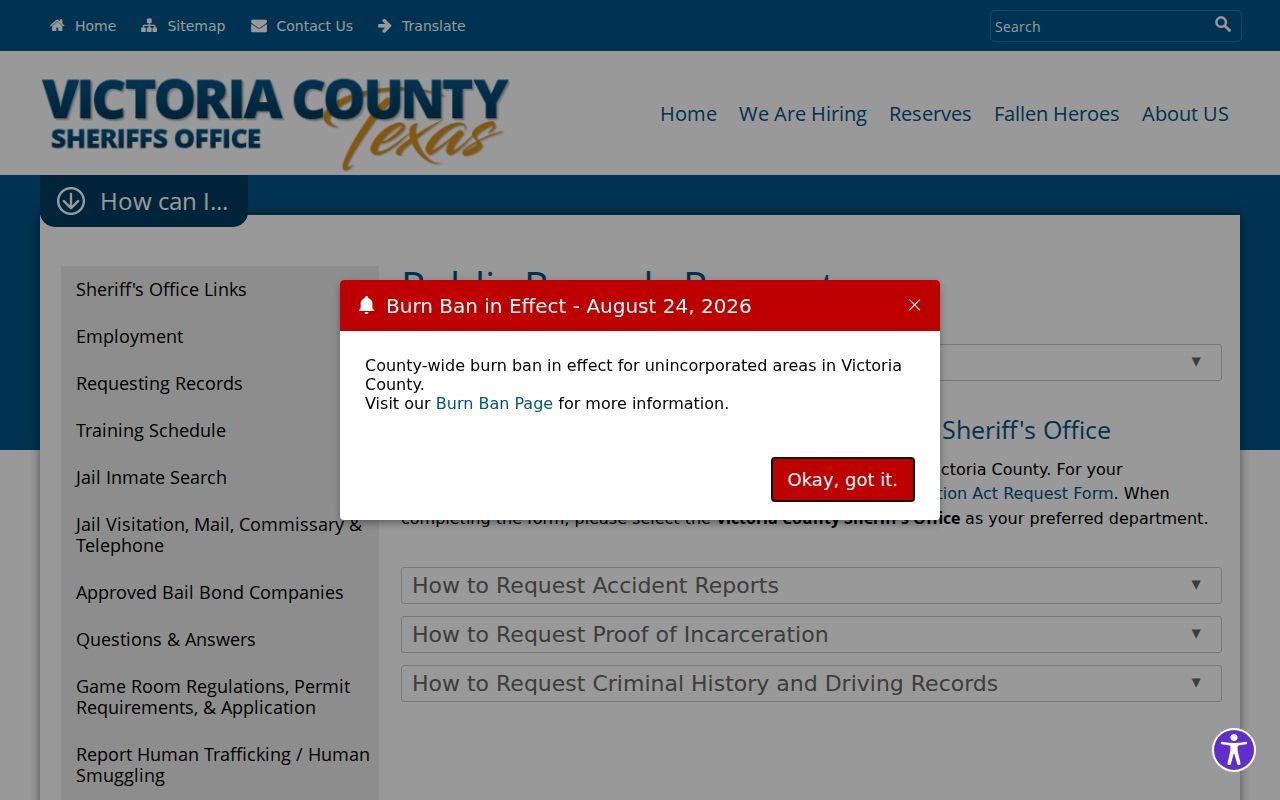
That path is record-specific: a phone question alone does not start a Sheriff public-information request, and another custodian may have a different request route.
Victoria Resident Records, Used Carefully
Public availability has limits. Texas protects some addresses and personal details for covered officials, protected voters, and participants in confidentiality programs. Library-use records and Neighborhood Watch participant details are also confidential. DMV information and utility customer lists are not public resident rolls. Do not try to fill those gaps by inferring a protected address from nearby data.
Watch for record scams as well. The county’s RNS can alert a registered name to future recordings, but it is a courtesy service, not title protection. Verify a deed-copy notice with the County Clerk, verify an alleged court demand through the official clerk or portal, and use Texas Comptroller ClaimIt directly rather than paying someone who contacts you about unclaimed money.
Note: Confirm a record with the office that holds it before relying on it for a personal, legal, or financial decision.