
Finding Victoria Residents by Record Trail
No master roster of Victoria residents exists. Each fact points to a different record. A deed ties an owner to a parcel. Voter files open public registration fields for an eligible voter, within confidentiality rules. A published city directory places a household in a particular year. Court, probate, business, and obituary material can then confirm that a same-name result belongs to the right person.
Start with the narrowest solid detail. A full name plus an address works best. Treat a name-only match as a lead, not a conclusion. Renters, household members, confidential voters, and people whose address is protected can be absent from the public trail entirely. The strongest Victoria residents directory search compares independent records rather than expecting one list to settle every question.
- Search Victoria CAD by owner, street, parcel, or legal-description clue when the question concerns a property.
- Compare the situs address, which identifies the parcel, with the separate tax mailing address.
- Use the county clerk’s recorded-instrument index for a deed transfer, then note the legal description and recording date.
- Check the proper court, voter, vital, library, or archive channel for a second dated fact.
- When the web result stops, ask the custodian, submit a written request, or use the local-history shelf.
Note: A property owner, a mailing recipient, and a current occupant can be three different people, so label each fact before comparing records.
Victoria Residents Directory Offices
A Victoria residents directory search leans on a few public offices. The Victoria County Clerk holds recorded property instruments, marriage licenses, probate material, and county records. Victoria Central Appraisal District manages parcel and appraisal data. The Elections Administrator handles voter resources and file requests. Their records overlap, but their purposes and access rules differ. The clerk's web copy is not the official repository. CAD and elections data carry their own limits.
Victoria County Clerk
115 N. Bridge St., Room 103
Victoria, TX 77901
361-575-1478
Victoria Central Appraisal District
2805 N. Navarro, Suite 300
Victoria, TX 77901
361-576-3621
Victoria County Elections
2805 N. Navarro, Suite 500
Victoria, TX 77901
361-576-0124
The Victoria streets resource covers the address side of this process in depth. It walks through parcels, legal descriptions, and historical street sections.
Victoria CAD Name and Address Search
Property searches in Victoria now run through the Victoria CAD eSearch portal. It is the strongest current starting point. Visible search choices include Owner Name, Street Number, Street Name, Property ID, and Geographic ID. Subdivision, Condo, Neighborhood, Abstract, Property Type, and Tax Year are also offered. One quirk matters. Enter a street name without prefixes, suffixes, or unit numbers. A plainer street or name string often works. A fully formatted address sometimes returns no parcel.
A returned parcel can show an owner, situs address, and mailing address. Legal description, tax-year information, and other appraisal facts also appear. It does not list every person at the property. Renters and other occupants often stay invisible. That limit is easy to forget. For a Victoria resident trail, confirmation beyond the CAD record helps. A deed or a dated directory entry is the better anchor.
| Victoria CAD field | Best use | Research caution |
|---|---|---|
| Owner Name | Start with a likely property owner | Use last-name, first-name format when needed |
| Street Number and Street Name | Find a parcel by physical location | Omit prefixes, suffixes, and unit numbers from Street Name |
| Property or Geographic ID | Reconnect a parcel after mapping it | Copy the identifier exactly |
| Subdivision, Condo, Neighborhood | Narrow a broad result | Autocomplete options were observed, but complete values were not captured |
| Tax Year | Review an available assessment year | The inspected page did not state its earliest coverage year |
Copy the parcel identifier and legal description before leaving the record. The identifier links CAD to the map. The legal description bridges to the deed. A tax mailing address can help locate a record, yet it is not the same thing as the situs address. Compare both fields carefully. Then use the clerk's index or a dated directory source to test whatever relationship the CAD result suggested.
Victoria Recorder Alerts and Limits
The county clerk's Aumentum/Manatron public-access portal opens behind a disclaimer acknowledgment. The county warns that web material may be incomplete, may not reflect the unaltered official record, and can be affected by redactions or image availability. The portal states no exact online index cutoff. That gap matters for older deeds. A Victoria residents directory search that reaches an early instrument may need the clerk's help directly.
Future recordings have their own tool. The clerk offers a free Recording Notification Service that alerts a registrant by email when a matching grantor or grantee name is recorded. A valid email address is all it takes. The service is not a title search. Only required grantor and grantee names must be indexed, and the county guarantees no completeness. For a historic document, call or visit the clerk. Ask about the particular instrument, copy, certification, or archive request.
Current Victoria Resident Directory Sources
Current directories in Victoria are purpose-built records, not one census of households. CAD leads on property ownership. County and state election channels hold voter information. Recorded instruments name the parties to a filing. The city staff directory lists public employees in their official roles. Each source can locate or verify a fact, yet none proves that every person at an address appears.
| Victoria source | What it can show | Custodian | Access path |
|---|---|---|---|
| CAD parcel record | Owner, situs, mailing, legal and tax facts | Victoria CAD | Public eSearch and map |
| Recorded instrument | Grantor, grantee, transfer date, legal description | County Clerk | Portal, counter, or copy request |
| Voter roster or file | Public voter fields for the selected request | County Elections | Roster links or written request |
| City staff directory | Official city personnel contacts | City of Victoria | Public category and name search |
| License or entity filing | Public filing or credential facts | Texas agencies | Agency-specific official search |
Official custodians name their records and their access limits. Paid collection sites blend public and commercial data, yet stale addresses and same-name mistakes slip in. For confirmation, a custodian record, a dated volume, or a certified copy wins.
Victoria Voter Files by Request
Victoria County's elections office connects voters to rosters, results, and other election resources. But a street-by-street roster of every registered voter is not on offer there. The county's broader route is a written voter-file request. A requester can scope it to precincts, a city, a school district, a commissioner precinct, or the whole county. The format can be email, CD, hard copy, or another choice.
The form spells out the costs. Emailed delivery is free. A CD runs $10 plus labor and postage. Hard copies cost 10 cents per page on the same terms. Processing is stated as within 10 days. A notarized affidavit limits commercial promotion or advertising use under Election Code §18.067. Public fields include name, date of birth, voter-ID number, and elections voted. They never show how anyone voted. Protected addresses and identifiers remain restricted.
Note: A roster reflects one election or request scope, not a complete current household list.
Victoria Court Records in Three Lanes
Court records can confirm a dated party, case, court, or disposition. They cannot prove where a person lives now. Victoria Municipal Court offers a case route for upcoming dockets and dates. It also covers final dispositions and related matters. Two limits apply. Its lookup does not show final dispositions at least five years old. Ticket data can lag one to three business days.
District, county, family, probate, and criminal cases run through Victoria County Odyssey. Texas re:SearchTX covers some of them too, where available. Odyssey's criminal instructions include case, defendant, citation, and attorney search modes. Name, date-of-birth, case-status, and filed-date options are supported. Before treating a hit as the right person, compare the case number, filing date, party role, and court. Sealed, juvenile, expunged, and adoption records are not ordinary name-search material. For certified copies, go to the clerk holding the case.
Victoria Vital and Family-History Routes
Vital records in Victoria sit with different custodians. The City of Victoria local registrar issues city birth and death certificates. The County Clerk handles certified marriage licenses. The District Clerk issues certified divorce decrees. Texas DSHS covers statewide records with forms, verification products, and qualified-person ordering. Texas Government Code §552.115 sets the waiting periods. Birth records open to the public after 75 years. Death records open after 25, subject to stated exceptions.
The state's marriage verification indexes start in 1966; divorce indexes start in 1968. For protected records, eligibility, identification, and the right form still govern access. The official DSHS forms page supports mail, Austin walk-in, and qualified-person ordering. An adult adoptee, birth parent, or qualifying biological sibling has a different route. The Texas Central Adoption Registry is the official matching path rather than an informal name search.
- Roll
- A list maintained for a defined public purpose, such as a voter roster or tax roll.
- Index
- A finding tool that points to a record. It is not always the record image itself.
- Parcel
- A defined piece of land used by CAD and map systems to connect property facts.
- Criss-cross directory
- The street section of a directory, used to move from an address to an occupant clue.
Historical Victoria Resident Directories
Victoria's printed directory trail is unusually well documented. UHV lists Scollard & Thomas for 1900–1901, Worley for 1913, Wilder for 1927, C.H. Jackson for 1939–1956, and Polk from 1957 into current reference holdings. The gaps are real. A missing year is a coverage gap, not evidence a household left town. UHV notes the name section can carry occupation and spouse details. The street section can work as a reverse directory.
Victoria Public Library's O'Connor Room adds Polk volumes, Advocate microfilm, obituary files, and local-history materials. Its Advocate index covers subjects, titles, issue dates, and pages from 1968–2004. Obituary files span 1981–1992. Microfilm reaches toward 1876, though older coverage is incomplete. UHV's Regional History Center is by appointment and may need advance contact for off-site material. The full collection and entry-reading approach sits on the Victoria city directory page.
Victoria Addresses Across an Expanding Grid
Address research in Victoria has a geography problem as well as a records problem. The city began on a one-mile grid near the central plaza. Growth came through annexation, stretching far past that original pattern. The 2025 Comprehensive Plan reports city acreage rising. It climbed from 2,013 in 1950 to 22,640 in 2007. An older directory address may need more than a modern street-number search. Directional forms, old street sections, plats, and the legal description can all help. They test whether two address references point to the same place.
The official Texas list confirms five Victoria ZIP codes, 77901 through 77905. A ZIP is a postal routing tool. It does not prove a city limit, parcel jurisdiction, or current residence. Use the USPS full-address lookup for ZIP and ZIP+4 delivery confirmation. Use CAD and GIS for the parcel, and the recorded legal description for ownership research. The City and County Street Index is especially handy. It covers E, W, N, and S street-name variants.
Victoria's five ZIP codes are summarized separately in the By ZIP resource. The limit stays clear. Neither a ZIP result nor a map polygon supplies a complete list of people at an address.
Victoria Archives Beyond the Portal
Victoria County's paper trail runs back long before any portal existed. Finding aids describe county land grants from 1837 through 1847. They also list Daniel and Linn real-estate and deed material covering 1834 to 1882. Cartwright tax, deed, field-note, and plat records round out the archive shelf. These older holdings can bridge a gap. A modern residents directory or records portal may stay silent about where its coverage begins. The 1892 courthouse, later restored, belongs to that same access story. No official source documents a courthouse loss, though. So skip any claim of a destroyed-record period for the county.
When the web search stalls, pick the channel that fits the record. Visit the courthouse counter for copies or archival years. File a written Texas Public Information Act request for nonexempt government information. Victoria Public Library holds reference material. UHV opens by appointment. Texas State Library finding aids map the statewide routes. A written request should name the office, the record type, a name or address, and a date range. It should also include any case, document, or parcel number. The Victoria County Sheriff records-request instructions show the written-request route plainly. That helps when an online index is not the right channel for the job.
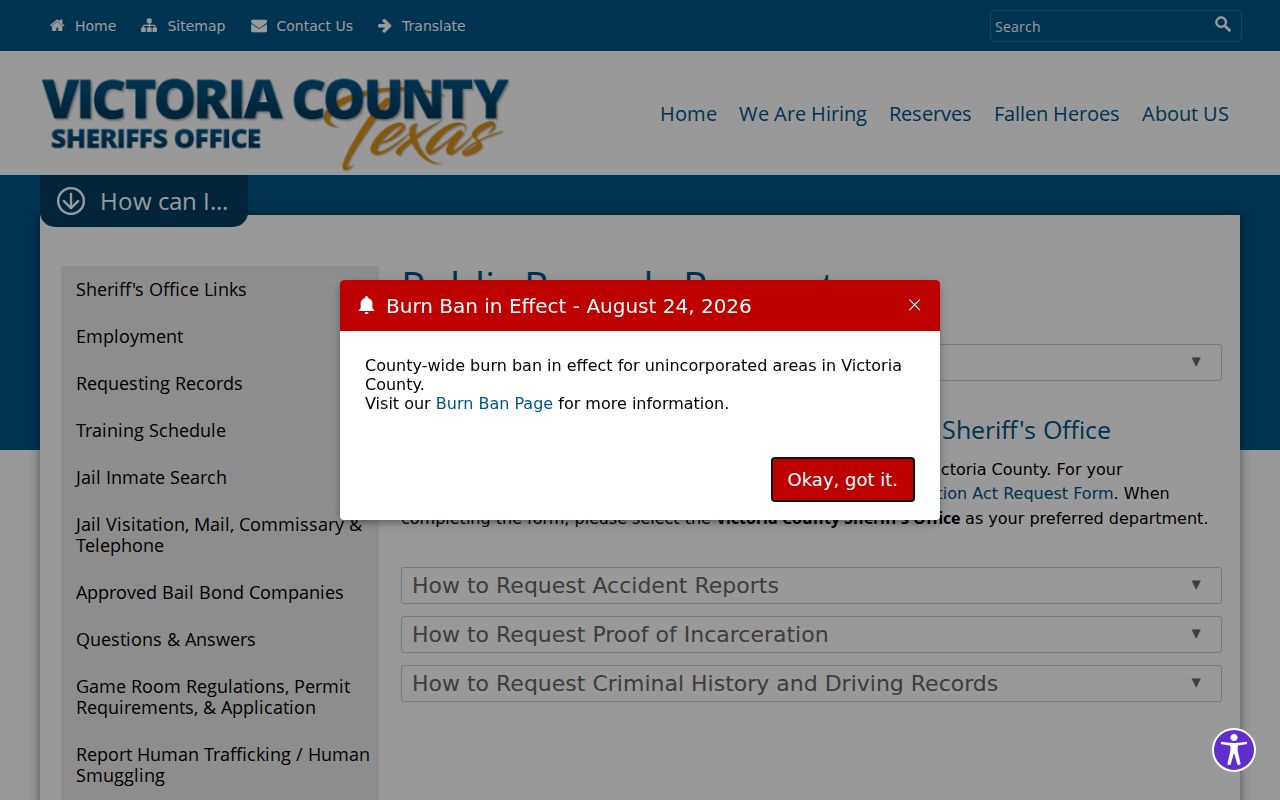
That path is record-specific. A phone call alone does not start a Sheriff public-information request, and another custodian may follow a different request route.
Victoria Resident Records, Used Carefully
Public access has firm limits. Texas shields certain addresses and personal details for covered officials, protected voters, and participants in confidentiality programs. Library-use records stay confidential. So do Neighborhood Watch participant details. DMV information and utility customer lists are not public resident rolls either, so never infer a protected address from nearby data.
Scams circle public records too. The county's RNS alert service can flag a registered name on future recordings. It is a courtesy, not title protection. Verify any deed-copy notice with the County Clerk. Confirm court demands through the official clerk. Use Texas Comptroller ClaimIt directly rather than paying someone who contacts you about unclaimed money.
Note: Confirm any record with the office that holds it before relying on it for a personal, legal, or financial decision.